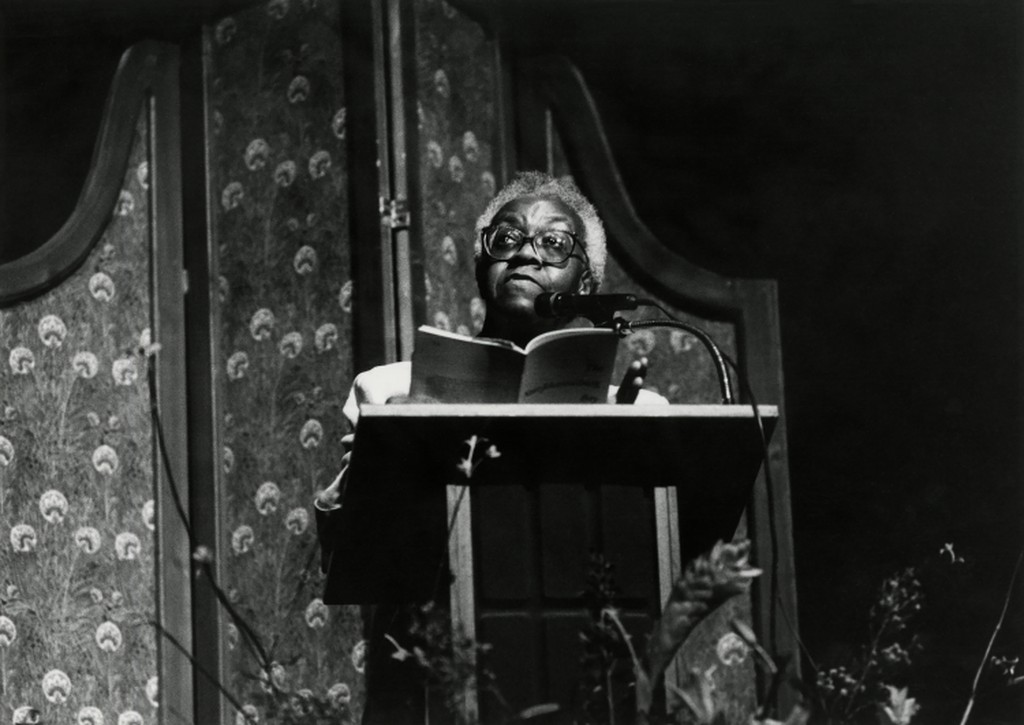
Credit: “Gwendolyn Brooks visit” by Karen Couture at Emerson College on Artstor
When looking at leadership and for leaders, it is easy to look towards the front lines to the loudest, most out-spoken individuals, but in the process people tend to overlook others. The ones they overlook may not be the loudest or use their voices at all, but instead use other platforms or forms of leadership. This is especially prevalent with leadership during the Civil Rights Movement. When most think of leaders during the Civil Rights Movement, they think of Martin Luther King, Jr., Rosa Parks, The Little Rock Nine, and Malcolm X, among others. They also tend to think of acts of leadership being found in the Montgomery Bus Boycott, Sit-Ins, Freedom Rides, and the various marches, including the March on Washington. However, there were other leaders that led during the time.
The Civil Rights Movement combatted a lot of evil and harm that blacks faced in the United States. Within segregation and Jim Crow, the idea of “separate, but equal” was widely spread by whitw conservatives that believed that blacks shouldn’t be in the same places they were and it became the public “norm.” Blacks were forced to endure longer waits, horrid conditions, and underrepresentation within their daily lives as a part of this “norm.” In order to overcome these horrors, many found communities that supported them and fought to make a difference. Another approach that people of color used to combat the oppression and violence that they were facing was through the Arts. There had always been influential people of color in the Arts, but there was an influx of new content and talent during the mid-1940s that lasted through the Civil Rights Movement into the 1970s. Within the Arts, written works and literature became a popular way to write about what was happening, either directly or indirectly. Through their work in the Arts, leaders began to emerge. One of those leaders was Gwendolyn Brooks.
Gwendolyn Brooks was born in Topeka Kansa in 1917, but soon after moved to inner-city Chicago where she was raised and remained for the majority of her life (“About Gwendolyn Brooks”). Brooks’ parents encouraged her and her brother to always “read and take an interest in culture” (Watkins, 53). Because of this, she became educated and began to write at a very young age. She was thirteen when she published her first poem and was frequently publishing in the Chicago Defender, a local newspaper, by age seventeen (“Gwendolyn Brooks”). As to what she wrote about, she once said, “I wrote about what I saw and heard in the street. I lived in a small second-floor apartment at the corner, and I could look first on one side and then the other. There was my material” (Watkins, 51). She graduated in 1936 from Wilson Junior College in Chicago, only ever receiving an Associates Degree (The Editors of Encyclopaedia Britannica). She grew up during the time of the Great Depression, which affected her ability to afford college. There also wasn’t a huge emphasis on women getting an education at that time and most women began starting families early on. Even though Brooks decided to get married and raise children, fulfilling the traditional female role at the time, she continued to write through it all.
In 1946 she published her first collection of poems, A Street in Bronzeville, which gained some traction, but not an overwhelming amount (“About Gwendolyn Brooks”). Three years later she published her next collection, Annie Allen, which won the 1950 Pulitzer Prize (Watkins, 51). Winning the Pulitzer Prize was significant in itself, but on top of the award, she became the first Black author to do so. Brooks and her husband were struggling financially when she heard that she had won and she later wrote, referring to the Pulitzer Prize, that “It is a smile” (“Gwendolyn Brooks At 100,” 31-32). After this, she became a more prominent writer in both the Black and White literary communities. She continued to write and went on to publish more than twenty books of poetry along with a handful of books (“About Gwendolyn Brooks”).
An example of Brooks work is The Bean Eaters in which she published one of her most famous poems, “We Real Cool.” In order to understand Brooks’ choices within the poem, one must first understand the social and cultural implications of the time period. This poem was written during the Jim Crow Era. However, there was a rise in the Civil Rights Movement in 1954, with the success of the Brown v. Board of Education Supreme Court Case. Within the case, the ideology of “separate, but equal” became unconstitutional under the 14th amendment. However, even during the desegregation of schools, the black community faced more verbal and physical oppression and violence. A line in Brooks’ poem reads,“We Left school,” (Brooks) which can be interpreted that the boys in the poem simply left after the school day or year, or that they dropped out. This is significant to the time period because there was approximately a five to ten percent difference in the enrollment rate of black and white students in high school (Snyder, 8). Additionally, only fifteen percent of black males twenty-five years and older had completed all four years of high school (Snyder, 7). Brooks alludes to these problems in her poem because of how relevant and critical at the time and how much of a turning point the decision of education was for these young individuals.
Brooks encompasses themes of isolation, discovery, and adolescence in her poem, which can be seen throughout her works. Brooks created the poem for the adolescence during the time period and to display their ability to distinguish and choose the direction that they wanted for their lives. Each line of the poem displays some form of choice that one may have to make during adolescence that can either be interpreted in a positive or negative connotation. The negative decisions seem to win in the end with the last line “die soon,” (Brooks) which comments on the oppression that young black people were faced with. Within the poem, Brooks utilizes repetition by repeating the word “we” at the beginning of almost all the phrases in the poem. By using the personal pronoun “we”, while it refers to the pool players, it also relates to the black community as a whole during this time. By doing this, Brooks creates a sense of trust with her audience. Finally, Brooks uses a somber tone to further hint at the realities of the time. With phrases like “real cool” and “die soon,” she starts and ends the poem in an offsetting, almost uncomfortable way. Overall Brooks leaves the interpretation up to the reader and lets them inflict their own experiences and choices onto it, affecting what they may or may not get out of it.
Brooks’ works have been widely read, interpreted, and analyzed. Brooks, herself, has also done much work within her life to help educate and represent those who were impoverished or marginalized. Brooks won numerous awards and honors throughout the course of her life. In addition to being the first black author to win the Pulitzer Prize, she was the first black woman to hold the position of poetry consultant to the Library of Congress (“Gwendolyn Brooks”). In 1968 she was named poet laureate for the state of Illinois (“About Gwendolyn Brooks”) and in 1976 she became the first black woman elected to the National Institute of Arts and Letters (Watkins, 54). These are just a few of the positions and honors she received during her career.
However, as much as Brooks was greatly celebrated, she was just as much criticized. She was primarily criticized by white literary critics and black civil rights activist for not being more open and speaking publicly on race relations and political problems. After she won the Pulitzer Prize in 1950, she was asked and “declined lecturing on race relations,” (“Gwendolyn Brooks At 100,” 32). Many people in the black community saw this as her denying her responsibility by not using her platform to help promote progression. Over the years as she gained more of a status, she began to use her voice more publically, but continually said that she was “not writing poems with the idea that they are to become social forces” (Stavros, 7) or with “preaching in mind” (Stavros, 14). Her critics tried to make their interpretations of her work the only or primary one. However, as Houston Baker eloquently puts it, “the critic (whether black or white) who comes to her writing seeking only support for his ideology will be disappointed… she has ever spoken the truth. And truth, one likes to feel, always lies beyond the boundaries of any one ideology” (Baker, 31). This speaks to Brooks’ essence and the way that she was able to write for a wide range of people and scenarios. Her work is able to resonate more deeply because readers are able to use their own personal experiences in order to gain meaning.
Instead of being at the front lines, Brooks worked from the bottom up, from behind the curtains. She once said that her “greatest interest is being involved with young people” (Watkins, 54). She believed strongly in providing opportunities for marginalized youth. She wanted them to be supported and to be given a chance to choose their destiny. When she became the poetry consultant to the Library of Congress, she often visited local schools and made sure to do what she could to support their writing programs. She also “began a poetry workshop in her home that included members of a Chicago street gang” among other at-risk youth (Watkins, 53). She firmly believed that writing was important for young people as a healthy way for them to express themselves. She also went to prisons to recite her own poetry and have them recite theirs. She once said that she would go to any prison she was invited to “because those people are truly glad to see you” (Brown, 50). Brooks believed in people and in humanity as a whole, but didn’t see her leadership role as something that was supposed to be in the public eye.
Overall, Brooks was not the loudest leader or the most out-spoken. However, she used her platform on her own terms to support underrepresented communities. Although she was criticized, she still found ways to lead in her community and promote change. She supported at-risk youth and communities in an attempt to nurture them to their full potential. Brooks did so in a way that wasn’t for publicity, or fame, but because she actually believed in their abilities and wanted to provide opportunities for them. Leadership does not have to look or sound a certain, stereotypical way. Brooks used her written work to help build a network that support at-risk and under supported young people. This is how she led, quietly, but powerfully.
Works cited
“About Gwendolyn Brooks.” Poets.org, Academy of American Poets, 2019, poets.org/poet/gwendolyn-brooks.
Baker, Houston A. “THE ACHIEVEMENT OF GWENDOLYN BROOKS.” CLA Journal, vol. 16, no. 1, 1972, pp. 23–31. JSTOR, www.jstor.org/stable/44328475.
Brooks, Gwendolyn. “We Real Cool.” Poetry Foundation, Poetry Foundation, www.poetryfoundation.org/poetrymagazine/browse?contentId=28111.
Brown, Martha H., et al. “GLR Interview: Gwendolyn Brooks.” The Great Lakes Review, vol. 6, no. 1, 1979, pp. 48–55. JSTOR, www.jstor.org/stable/20172474.
Couture, Karen. “Gwendolyn Brooks visit.” (Varient Title: Poetry reading). Emerson College. April 15, 1991. Artstor, library.artstor.org/asset/22450019.
“Gwendolyn Brooks.” Poetry Foundation, Poetry Foundation, 2019, www.poetryfoundation.org/poets/gwendolyn-brooks.
“Gwendolyn Brooks At 100.” Crisis (15591573), vol. 124, no. 2, Spring 2017, pp. 31–33. EBSCOhost, search.ebscohost.com/login.aspx?direct=true&AuthType=ip,shib&db=ahl&AN=126854161&site=ehost-live&scope=site.
SMITH, PATRICIA. “Gwendolyn Brooks.” Poetry, vol. 200, no. 1, 2012, pp. 58–61. JSTOR, www.jstor.org/stable/23249372.
Smith, Tabathia. “Gwendolyn Brooks.” Umoja Sasa, vol. 5, no. 7, 1979, pp. 1–5. JSTOR, www.jstor.org/stable/43690415.
Snyder, Thomas, editor. 120 Years of American Education: A Statistical Portrait. US Department of Education, 1993, National Center for Education Statistics , https://nces.ed.gov/pubs93/93442.pdf.
Stavros, George. “An Interview with Gwendolyn Brooks.” Contemporary Literature, vol. 11, no. 1, 1970, pp. 1–20. JSTOR, www.jstor.org/stable/1207502.
Tinkham, Charles B. “For Gwendolyn Brooks.” Phylon (1960-), vol. 29, no. 1, 1968, pp. 18–18. JSTOR, www.jstor.org/stable/274079.
The Editors of Encyclopaedia Britannica. “Gwendolyn Brooks.” Encyclopædia Britannica, Encyclopædia Britannica, Inc., 3 June 2019, www.britannica.com/biography/Gwendolyn-Brooks.
Watkins, Mel. “Gwendolyn Brooks (1917-2000).” Black Scholar, vol. 31, no. 1, Spring 2001, p. 51. EBSCOhost, doi:10.1080/00064246.2001.11431124.

Leave a Reply